|
Interview
by Eric Tobey
This
interview was taken from the Die Neue
Feldpost newsletter & was done
so with permission of the publisher.
We would like to thank him for his
generosity as well as thank all those who
have contributed to this article. It
is with their efforts, we are able to share
this valuable research with the rest of you.
As
one would expect with any veteran of the
Waffen-SS, it took quite a while to get this
individual to grant an interview. When
he eventually agreed, however, it proved to
be well worth the wait.
"Karl" was intelligent, had a good
memory for details, and spoke excellent
English. He also had a very forceful
personality which tended to take control of
the interview! He managed to fill a
lot of the interview-time with studied
comparisons of European liquors and modern
politics, but overall the meeting was both
enjoyable and educational:
How
did you wind up in the SS?
Like many things in life, it was not
planned. During the fifth year of
Gymnasium, male students had to pick one of
the services to be inducted into. I
chose the Kriegsmarine. They took me
to Hamburg and gave me a ride in a U-Boat
and a minesweeper. A little while
after that I was sleeping on the couch in my
family's home in Upper Silesia when my
father wakes me up saying, "Karl!
They are coming to arrest you!"
He had seen an SS man walking up our
walkway, but they were only coming to take
me to the induction physical! This NCO
and 3 others escorted 22 of us to our
examination. After graduation, I
reported in Breslau. This was in June
of 1944....
First
I had basic training, then NCO school, then
officer school. The whole process took
5½ months. Early in the war it took 2
years to become an SS officer, and the older
officers never let us forget it. But
late in the war, it was made much faster.
Basic training lasted about a month, maybe a
little longer. About 2 or 3 months
into the schools I went to the front for my
"Zwischen-Prüfung".
This is where you went to the front to prove
that you had the right stuff. You were
supposed to go for 6 weeks, but I stayed for
only 3. I got training for armored
officers in Posen-Treskow. After a
total of 5½ months, I bought my first set
of shoulder-boards; they cost me exactly 2
Marks and 80 Pfennig. My commanding
officer presented them to me.
I
went to the Ostfront at the end of 1944 and
joined the 3rd SS Panzers, I was in the
Panzer-Jägers. We were equipped with
Panzers that had no Turm (turret). Our
Divisional name was "Totenkopf",
this was from our emblem which was the
traditional emblem of the German Cavalry.
Ah! History has us as criminals, but
we were not criminals, we were soldiers!
At
the end of the war we tried to surrender to
the Americans, but as I was crossing a beet
field I was heavily wounded. The
Americans picked me up and took me to the
Russians and dumped me off. I was in
Stalin's prisons for a long time.
Did
you have any pre-military training?
Were you in the HJ?
Of course I had training, everyone did.
For students like us we had 6 weeks in the
summer and 2 weeks skiing in the mountains
in the winter. Training was done in
the Wehrertüchigungslager.
This was a military style camp run by the
regular army. The instructors were
decorated front-line soldiers.
What
can you tell me about your SS training?
When I was at the armor school in Posen,
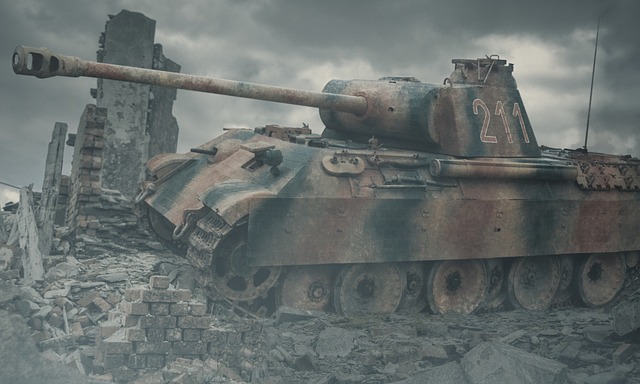
we learned to drive tanks in this Tiger tank
that had no Turm (turret). Our
instructor was this mean Hauptsturmführer
who was missing an arm. We called him
the "one-armed bandit". He
had five tank destruction strips on his
sleeve. Many of the instructors were
invalids, but they were good instructors.
Anyways, he had this metal sign on a stick
that was used to signal vehicles in column.
The Hauptsturmführer would use this to
whack us on the legs as we drove.
"Turn!" WHACK! He was
mean. Well there was this bridge that
was just wide enough for a tank with
quicksand on both sides. We were
approaching this bridge, and I was just
going to pull the Hebel (handle) to make the
left turn to get on the bridge. But
the one-armed bandit wacked my knees with
that sign and yelled "Right turn!"
When I didn't he hit me again - "Right
turn, that's an order!!" So I
pull the right Hebel and the tank goes into
the quicksand and started sinking fast.
We students all got out but the one-armed
bandit couldn't. Nobody liked this
guy, we thought about letting him go down
with the Panzer. But I threw him my
belt and he grabbed it. I held onto a
root or something with one hand and pulled
up with the belt. We all walked back
into camp covered with this green slime, but
all walked behind him so they would see his
mess first. He never said a word to me
because he knew it was his fault. They
had to use this big crane to get the Panzer
out.
We
had another instructor who was a big healthy
guy with no decorations. He must have
had pull because any officer from the front
would at least have the Iron Cross Second
Class. He was our instructor for Judo
and Polizeigriffe (Police-Holds). Most
of our instructors were decorated invalids.
In
the American Army, soldiers can buy luxuries
at a "PX". What was the
German equivalent?
We call this stuff "Marketenderwäre".
In our army you didn't have to buy it.
Early in the war, the company Zahlmeister
would give out little slips which could be
traded for Marketenderwäre. In
permanent camps in the Hinterland it was
given out in a "Kantine". In
the field, it would be a "Feldkantine".
In the field, this service would be in a
building, tent, or even in the back of a
truck. When you had time, you went
there and got the stuff you wanted.
Later in the war they didn't give the slips.
Instead, when you got stuff like soap or
cleaning brushes, they would put a stamp in
your Soldbuch. You could buy
cigarettes and alcohol - vodka and cognac.
Shoe creme, soap, Scheißpapoer (toilet
paper), toothpaste, letter paper, pencils,
and so on. The two most important
items were tobacco and alcohol. Some
of the Marketenderwäre were requisitioned
from the local area. You could get
your Marketenderwäre even on the last day
of the war, even a few days after the war
was over! If this was to happen in
America, you would be lucky to get a single
cigar a month before the collapse. The
Germans are very efficient.
In
fact, in Germany we have a saying - "Ordnung
muß sein!" (There must be order!)
They have a big sign with this in a beer
hall. Even in the beer halls, there
must be order. And efficiency.
And be punctual! We have another
saying - "Fünf minuten vor der Zeit,
ist Soldatenpunklichkeit." (Five
minutes ahead of time is soldierly
punctuality.) When this guy here (our
host) came to pick me up, he was only 15
minutes late. Actually pretty good for
a Yankee. In Germany you can set your
watch by the trains....
At
this point, our host brings out a package of
German pipe tobacco from his collection and
shows it to him:
Ah,
yes! This tobacco must have been sold
as Marketenderwäre during the war!
You see this stamp on the tax sticker?
It says "Steuerbegunstigt",
which means that there was no tax to be paid
on it because it was sold to soldiers.
What
were "Iron Rations" like?
They were only supposed to be eaten upon
order, like when you were cut off. But
we ate them a lot. There was canned
meat, it was ground pork. It was
excellent! I wish I could get some
now! Heated up, it was very good, it
was well spiced. There was also canned
ham, but the ground pork was the best.
There was also chocolate for survival and
Zwieback which is like a big cracker.
Do
you remember any of the songs you sang?
Yes, yes! We sang all the time!
We sang Der Blaue Dragoner... (and he
begins to sing the song...)... and Panzerlied...
(he sings this one too, and when I join in
he begins to direct me like a conductor!)
Oh yes, the Panzerlied. We sang it in
training and in the field too. It came
from the Afrika Korps, thats why the lines
say "...in the cold of night, heat of
day, dust on our faces, " and so on.
We
also sang a lot of Navy songs, its true,
like "Wir fahren gegen England"
and "Der Tag war grau, der Tag war
schwer"... (he begins to sing
again).
We
didn't sing the Horst Wessel Lied,
that was a party song. A Nazi party
song. We didn't sing it.
How
about this one... "Siehst du im
Osten das Morgen Rot"... (more
singing)...
(Finally
interrupting) - ... How about Skat?
Did you play...
No, wait!! I have more songs!
We sang the Grenadier Song.. (begins to sing
again).
We
also sang the SS song (singing again)...
"wenn alle untreu werden...."
Sometimes we changed the words to songs,
like this one where there was something
about longing to being the "neue Zeit"
(new times), we put in "alte Weib".
So we longed to be in the "old
lady!" Ha, Ha, ha! "Weib"
is a coarse word for wife or woman, its not
very nice. Ah yes, we would spice up
the words to some songs. We were young
and romantic.
There
was a song called "Lili Marlene"
that was sung all the time.
Soldatensender opened and closed their radio
program with it.
Lots
of songs were about the "Heimat".
Nobody ever translates this word correctly.
It always comes out as "homeland".
This is incorrect. There is a very
important difference between these two.
Heimat is your home region or community, but
not really your hometown, either. Your
Heimat would be called the "Southern
Tiers" I think. Your Vaterland
would be the U.S. There was also
another word - "Hinterland".
This was not necessarily Germany, it could
mean Poland or Czechoslovakia.
How
about the card game Skat? Did you play
this?
Yes, it was a common game, I still
remember how to play. But we would not
say "play" Skat. We would
say "Skat klopfen" (pound
Skat).
Did
you ever collect souvenirs?
We didn't have time to pick up
souvenirs, we were too busy fighting!
We did use some Russian equipment.
After our tank-destroyers ran out of gas, I
took over a Battalion Infantry Platoon.
These groups were made from tank-destroyer
men with no tank-destroyers, tank men with
no tanks, and guys like that. My
platoon sergeant says to me -
"Untersturmführer..." you see, we
could say that in the Waffen SS. You
could call your superior by just his rank or
even his first name. In the Army you
would have to say "Herr Leutnant"
but not in the SS. We used "du"
instead of "Sie". We had
Kameradschaft in the SS! Anyway, my
platoon sergeant says - "Untersturmführer,
throw away that Spielzeug (play-toy)",
...he meant my German machine pistol...,
"...and I will give you a weapon that
is reliable!" Then he hands me
this Russian machine pistol. We called
them "Finka" like the
Russian soldiers did. I think this
name came from the war in Finland. You
see, the German machine pistol was a well
made weapon, but get some sand in the thing
and bye bye!! The Russian gun had this
wobbly Schloß (bolt) and looked like
something some village blacksmith would have
made. But it worked! One of our
men demonstrated once by throwing handfuls
of dirt into the Schloß of one of them, and
it still fired!
Which
were more popular, Footwraps or socks?
The Fußlappen were squares of cloth
that you wrapped over your socks to keep
your boots on better. You wore them
with your Marschstiefel (Jackboots) or as we
called them "Knobelbecher" (dice
shakers). We did not wear them with
our Schnurschuhe (low-quarters) and
Gamaschen (gaiters - he pronounced it like kah-mah-shen).
Americans would call this lace-up footwear
"boots", but in Germany, if it had
laces, it was called "Schuhe".
(This is not totally correct.
Paratrooper boots were called "Fallschirmjägerstiefel".)
I don't think that the Fußlappen were
supposed to be worn by themselves, although
units would wear just the Fußlappen if
their socks wore out.
What
decorations did you receive?
I got an Sturmabzeichen, Wound Medal I
got from a Katyusha rocket fragment that
still rests against a major nerve, and the
Iron Cross First and Second Class. I
don't remember what I did to get the Second
Class Cross, my God, they even gave it to
Hitler Youths who just stayed at their posts
during an air raid. It is interesting
how I got the First Class Cross. I was
out of shells for my tank. The
Russians had overrun this big pile of our
shells and you could actually see this pile
only a kilometer or so behind the Russian
battle-line. So I ordered my driver to
drive for it, and we drove through the
Russian lines to get the ammunition.
When we got there we loaded all we could and
then drove back to our lines. Somebody
who saw me do this told somebody else, and I
got the First Class Iron Cross. It was
not bravery, if I was my commanding officer
and knew what I know now, I would have had
myself court-martialed. All I did was
endanger my tank and my crew. I don't
remember how much fire we took when we did
it.
I
have been told that one nickname that Army
troops had for the SS soldiers was "Herrenmensch".
What do you know of this?
Ach! This was never applied to SS
soldiers! It applied to the Party!
Herrenmensch means something like
"Lordly one". You see, the
Herrenmensch were supposed to rule over the
Untermensch and rule Europe. This was
a party idea. This was not a very nice
word for anyone, either.
|