|
Late-War German Ammunition at the Front 1945
By Jeff Johannes & Douglas Nash
|
|
In
the final months of the Third Reich, the chronic
shortage of raw materials required for the production
of weapons and ammunition was being felt throughout
the front lines. Equipment, uniforms, and weapons were
being made with whatever substitute materials that
were available, or, as the Germans themselves called
it, “Ersatz,” that could be used in manufacturing as
part of the vain attempt to sustain the German war
effort for another day. Even the most sacred of
soldier material – ammunition – was also being made
out of substitute materials, such as lacquered steel,
in order to get the most out of the dwindling
stockpiles of copper and zinc. This late-war lacquered
steel “Ersatz” ammunition, which was supposed to
increase protection from corrosion while reducing the
amount of strategic materials, such as copper and
zinc, required for manufacturing, was to have
detrimental effects to the soldiers on the front
lines.
The following is an account of such lacquered steel
ammunition being used in the finals battles around
Berlin, as told by Gunther Labes, a Panzer Grenadier
who was assigned to the 3rd Battalion, 2nd
“Müncheberg” Panzergrenadier Regiment, Panzer Division
“Müncheberg.” Labes, who was assigned as an Assistant
Machine Gunner (MG Schütze 2), along with other
members of his company (most of whom were formed from
other units or stragglers a few days earlier), were
positioned along the defenses of Seelow Heights when
the Russians initiated their Berlin Offensive on April
16th, 1945.
“Due
to the lack of suitable raw materials, such as copper
and zinc, the cartridges for our rifles and machine
guns were no longer being made of brass, but of normal
steel. The unprotected steel would have normally soon
rusted but, as no soldier in the German Wehrmacht
could have rust on his arms and ammunition, the Aryan
masterminds of the greater German Reich had come upon
the solution of dipping the cartridges in transparent
lacquer to prevent rusting. One would surely be
overestimating the intelligence of those responsible
for this decision if one accused them of sabotage! The
effect this measure had on fire power of our troops is
almost indescribable. The 98 Carbine then in general
issue as an infantry weapon was meant to be used as a
repeater, but as a result of the lacquering of
cartridges, the ejection of empty cartridges after
firing by means of lifting and pulling back the bolt
was only seldom possible, and even then only within
half a second of having fired. Usually the short time
it took to reach for the knob of the bolt was
sufficient to enable the cartridge to burn fast in the
breech. When this occurred regularly, it was not very
clever to present oneself as a target to the enemy
while trying to clear the breech under cover. The
rifleman therefore had to go back into the trench with
his unusable weapon each time after firing and by
hammering the knob of the bolt with either a hefty
kick or a blow from his bayonet, pull back the bolt
and force the empty cartridge out of the breech with
his ramrod, providing it was long enough. Sometimes a
hard bang of the stock on the bottom of the trench
sufficed.

As No. 2 on the machine gun, I also had to use my
ramrod on the spare gun barrels as the last cartridge
regularly burned fast in the breech after a burst of
fire, and consequently the barrel had to be changed
after each burst and a fresh belt of ammunition fed in
to prepare the next burst.
Looking back, I cannot help thinking that the
musketeers of the Thirty Years War with their 17th
Century weapons had a faster rate of fire on average
and consequently greater firepower than we infantryman
of the 20th Century with our modern automatic weapons,
but supplied with lacquered ammunition!”
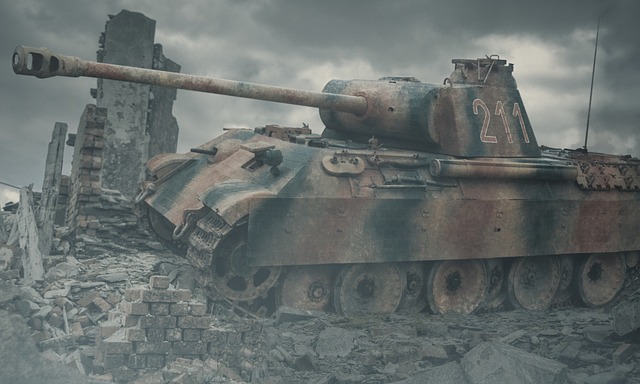
An ironic twist concerning the Münchenberg Panzer
Division was that, at the time, it was one of the most
modern-equipped military units in the world. Several
of the Division’s Panzerkampfwagen V “Panther” Model
Gs were equipped with FG 1250 Sperber (Sparrow)
Infrared (IR) fire control systems, which was designed
to be used in night combat, a ground-breaking
innovation at the time. A company of Panzer Grenadiers
was also equipped with the Vampir (Vampire) ZG 1229
Infrared System mounted atop their MP-44 Sturmgewehr
assault rifles, but the bulk of the division’s
infantry were still equipped with the obsolete Mauser
98 Carbine. One can only imagine the frustration of
the members of this Division, which simultaneously
fielded state-of-the-art equipment alongside some of
the worst that left them virtually defenseless.
| - |
“Death Was Our
Companion” by Tony Le Tissier. Sutton
Publishing Limited, 2007. |
| - |
“Nightfighting
Panthers” found at http://strangevehicles.greyfalcon.us |
BACK TO ITEMS
|