|
The
"A" Frame Bag
By
Doug Nash
|
|
One
of the most misunderstood and puzzling items of German
WWII accoutrements is the little bag that attaches to
the assault pack, commonly known as the “A” frame
bag. While
many people purchase this item of equipment when they
build up their German impression, they do so without
truly understanding its actual purpose.
In the hopes of exploring the origins of this
little item and shining a little light on this aspect
of the life of the ordinary Landser, this article will
review the history, design specifications and
regulations outlining its utilization.

Up until the mid-1930s, the German infantryman had
gone to war carrying his extra underwear, socks,
shelter quarter, blanket, extra boots and iron ration
in the horsehair-covered Tornister, or backback.
This heavy and ungainly item became one of the
images that came to mind, along with the Pickelhaube,
when one thought about the German soldier of the Great
War.
In line with the evolving doctrine that foresaw
Germany
’s next war as one of mobility and movement, the new
Wehrmacht gave much thought to lightening the
soldier’s load and providing him with field
equipment that was as compact and functional as
possible. Since
it was large and cumbersome, many of the officers of
the Army’s uniform board recommended replacing this
venerable backpack (known with little affection as the
“Schwere Affe” or “heavy ape”) with something
more ergonomically functional.
To this end, the Oberkommando der Heeresleitung
or OKH issue an order in early 1938 that called for
the lightening of the soldier’s basic load and
experimentation on what means would work best to allow
the soldier to carry the most of what he needed with
the smallest amount of impedimenta.
To
make a long story short, after several months of
experimentation and field-testing, the Army’s
uniform board settled on adopting the Battle Pack or
“Gefechtsgepäck” and issued an order requiring
its adoption on 12 July 1938 for use by infantry
units. This
item consisted of a webbing pack frame with a small
canvas bag, to be utilized as a standard assault pack.
Attached to this by two leather (later canvas)
straps was the Zeltbahn and standard mess kit.
In turn, the Gefechtsgepäck was attached to
the supporting straps (Trageriemen or “Y” straps)
utilizing the D-rings attached to the straps for that
purpose.
The
bag for the Gefechtsgepäck, officially labeled the
“Beutel zum Gefechtsgepäck,” was made out of
olive-brown or gray light canvas and measured 28 x 13
x 8.5 centimeters.
Its flap had an inside pocket that allowed the
Landser to store his rifle cleaning kit model M34.
The regulation also specified that the bag
would contain the following items and the following
items only: one
woolen sweater (Schlupfjacke), 1 half Iron Ration (verkürzte
eiserne Portion), and 1 tent line (Zeltleine).
The half iron-ration consisted of a can of beef
or pork measuring 3” x 2 ⅝”, weighing 200
grams, and 300 grams of hardtack crackers (Hartkeks).
Together, these items were fairly bulky and
took up most of the space in the Beutel zum
Gefechstsgepäck, once they had been placed in the
mythical “ration bag.”

Once
packed, the Beutel was closed utilizing two lengths of
webbing tape that were passed through a steel grommet
on each side. The
bag itself was affixed to the Gefechtsgepäck by means
of a short webbed tab on each side that fastened with
a steel button. If
required, a greatcoat and blanket could be attached to
the pack using leather or canvas straps passed through
3 metal D-rings sewn into the top and sides of the
frame itself.
Carried
in the platoon’s baggage train (which consisted on
one wagon per platoon) was each Landser’s Tornister,
not worn but packed with his Greatcoat, 1 pair of
lace-up boots, 1 shirt, 1 pair of socks, 1 pair of
twill trousers, 1 hand towel, and washing, cleaning
and repair equipment (soap, brush, sewing kit, etc.).
Also packed or strapped to the Tornister were
the pole sections for the Zeltbahn and two tent
stakes. Needless
to say, if the soldier was far away from the company
trains (Tross), he might not see his Tornister for a
long time, a common experience, especially during the
early days of the advance in
Russia
.
What
was the average Landser to do if this were the case?
The problem with his equipment was that it was
specifically designed to prevent him from carrying
anything extra and the size of the bag on his
Gefechtsgepäck made it nearly impossible to carry
what the regulations required, much less anything
extra. The
only recourse was to carry as much as one could in
one’s uniform pockets or breadbag (Brotbeutel),
which wasn’t very large either.
Experiments done by the author show that it is
nearly impossible to fit the iron ration, rifle
cleaning kit, tent rope, and sweater into the tiny
little bag (it works if the sweater is very thin or
nearly threadbare!).
When you try to affix the bag to the A frame in
the conventional manner (with the Zeltbahn on top), it
becomes almost impossible to fit anything in it except
the cleaning kit and iron ration.
And even then, it becomes very difficult to
gain access to the bag to get to the ration, unless
you stop and remove your Y-straps or have a Kamerad do
it.
Which
is exactly what the Heer uniform advisory board
wanted, I believe.
The only way an individual under close
supervision could get to his iron ration or cleaning
kit or sweater in combat or on the march was if he was
ordered to do so and was helped by a Kamerad.
Thus, while a hungry Landser may have been
tempted to make a grab for his iron ration, it was
challenging to do so without being caught.
Since the iron ration could only be consumed on
orders, it made the enforcement of this edict rather
easy. Therefore,
a very practical and ergonomic piece of equipment also
made the maintenance of discipline somewhat easier.
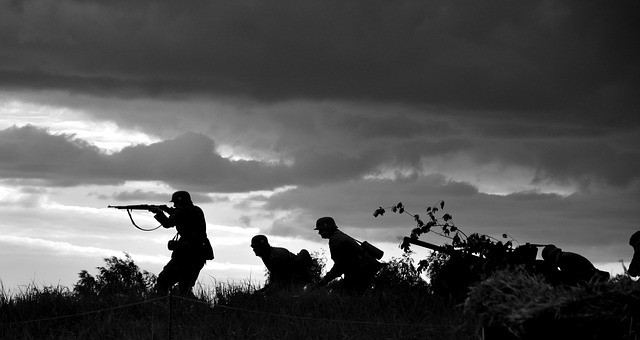
Most photos taken of soldiers in combat from
1939 – 1943 show Landsers wearing their equipment in
the prescribed manner.
As
the war progressed increasingly against
Germany
’s favor, the scarcity of strategic materials, such
as canvas, resulted in the A frame and bag being
issued in smaller quantities and usually only to
infantry units. As
the Wehrmacht’s professionalism and discipline began
to break down by mid-1944 due to the enormous losses
in small–unit leadership caused by fighting a
three-front war, the enforcement of uniform
regulations began to be increasingly relaxed.
By late 1944, the A frame with its cursed
little bag became a rarity, as troops increasingly
used the far more practical Rucksacks to carry their
kit with increasing frequency.
Though Landsers may have carried more weight in
their Rucksacks, evidently they preferred that as
opposed to being able to carry too little in the A
frame bag.
Sources:
- Gepäckerleichterung der
Schutzenkompanien der Infanterie, OKH Regulation
Number 541/38 g,
12 July 1938
.
- Feldgrau:
Mitteilungen einer Arbeitsgemeinschaft,
Volume 2, Number 2, March 1954.
(Friedrich Schirmer Publishing, Hannover,
Germany, 1954), pp. 1 – 3.
- German Rations and Subsistence Items, Volume
II.
U.S.
Army Quartermaster Food and Container Institute, May
1947, p. 2 and 20.
- John R. Angolia and Adolf Schlicht, Uniforms and
Traditions of the German Army 1933 – 1945,
Volume 3. (San
Jose: R.
James Bender Publishing, 1987), pp. 66 and 70 – 7.
BACK
TO ITEMS
|